
Ship-side retrofits that lower fuel cost, cut emissions and prepare the vessel for FuelEU and EU ETS compliance, installed and commissioned by our own engineers.
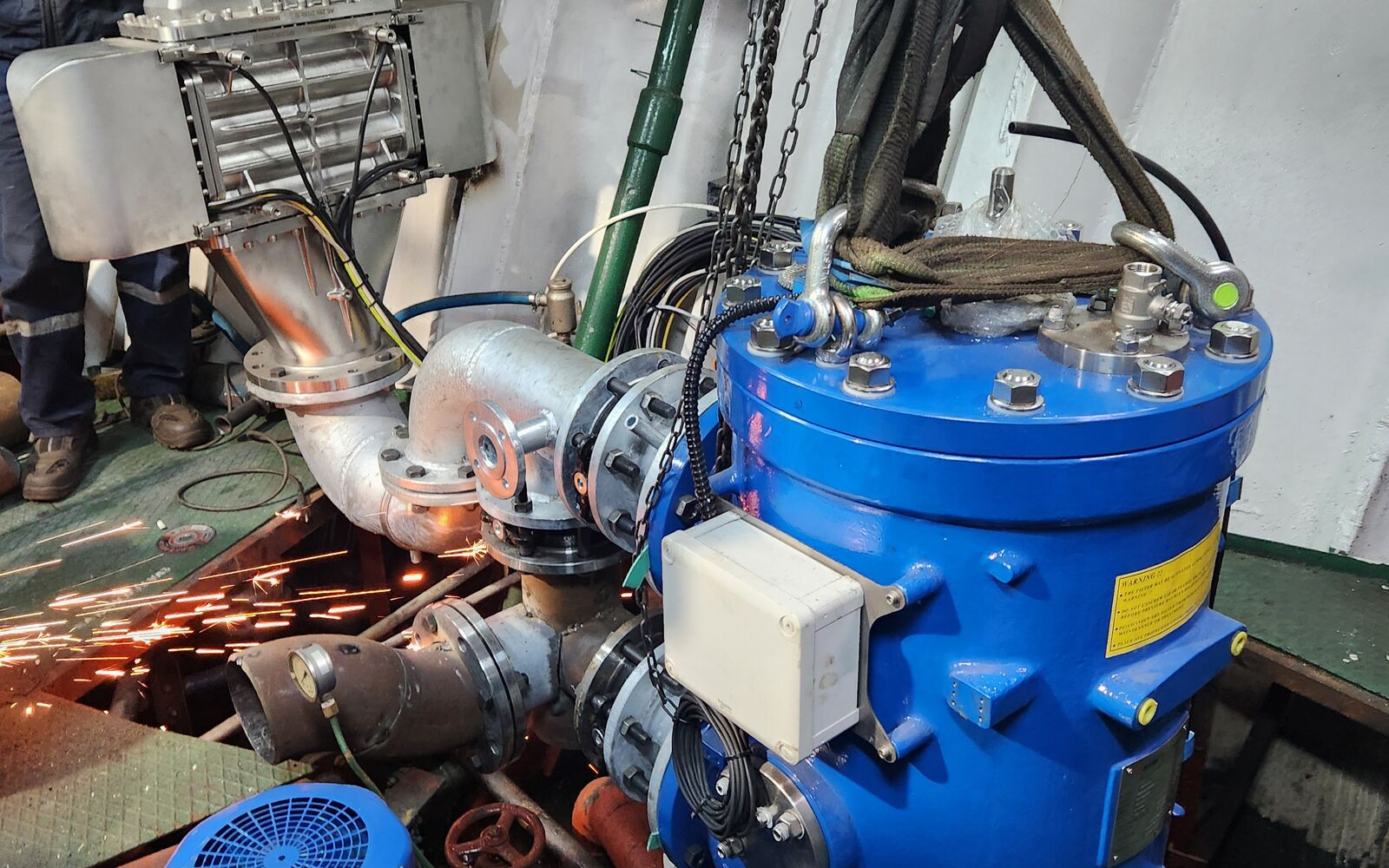
Three regimes now put a price or a rating on every tonne of fuel. Retrofit decisions start here.
| Regime | Who and when | What it means on board |
|---|---|---|
| EU ETS | Cargo and passenger ships of 5,000 GT and above since 2024. Offshore ships of 5,000 GT and above from 2027. | Allowances for 100% of emissions between EU ports and at berth, 50% on voyages to or from a non-EU port. Phase-in: 40% of 2024 emissions, 70% of 2025, 100% from 2026. Surrender by 30 September each year. Methane and N₂O included from 2026. |
| FuelEU Maritime | Ships of 5,000 GT and above calling at EU and EEA ports, since 2025. | GHG intensity of the energy used must fall below 91.16 gCO₂e/MJ by 2% from 2025, 6% from 2030, 14.5% from 2035, rising to 80% by 2050. Penalty €2,400 per tonne of VLSFO-equivalent in deficit. Banking, borrowing and pooling allowed. |
| FuelEU shore power | Container and passenger ships at berth in the main EU (TEN-T) ports, from 2030. | Connect to shore power at berth unless an exemption applies, or pay a penalty. |
| IMO CII | Ships of 5,000 GT and above, since 2023. | Rated A to E every year. A D rating for three years running, or a single E, requires a corrective action plan in the SEEMP. |
Summary for planning only. The regulations and your verifier's interpretation govern. Sources: Directive (EU) 2023/959, Regulation (EU) 2023/1805, MARPOL Annex VI.
EU ETS cost of one tonne of VLSFO burned between EU ports or at berth in 2026: about 3.15 tonnes of CO₂, so 3.15 allowances, at an assumed €80 per allowance. On top of the fuel price. Run your own vessel →
Each retrofit is delivered with a European manufacturer we partner with. We size the system with them, install it and commission it.
Lithium-ion battery systems for hybrid and electric propulsion and hotel load. Ortech is an authorised MG Point for MG Energy Systems; the RS 230 marine battery is Lloyd's type-approved.
Engineering points: space and weight, ventilation and fire protection of the battery space, integration with the power management system, and class approval of the design.
Partner details →BluEco shore-power systems from Blueday Technology, so vessels can shut down diesel generators at berth and meet port emission limits.
Engineering points: IEC/IEEE 80005-1 (high voltage) or 80005-3 (low voltage) connection, and 50 / 60 Hz: most European grids run at 50 Hz and many ships at 60 Hz.
Partner details →Teknoton fuel flow meters and telematics for main engines, auxiliaries, generators and boilers.
Why it matters: measured consumption for EU MRV and CII reporting, instead of estimates from bunker notes and tank soundings.
Partner details →Harsonic ultrasonic systems that stop biofilm forming on hulls, sea chests and box coolers, without chemical discharge.
Installation: afloat, without dry-docking.
Partner details →nC Protect passivators and sprayable insulation for ballast tanks, holds, void spaces, decks and pipework.
Aim: longer asset life and fewer paint cycles between dry-docks.
Partner details →Normec Verifavia, accredited to ISO/IEC 17029, for EU ETS, FuelEU, IMO DCS, CII and IHM / Hazmat.
Our part: local liaison, document preparation and on-vessel inspection coordination.
Partner details →Estimate the vessel's EU ETS and FuelEU exposure, and which retrofit moves the number most for its operating profile.
System sizing and design with the manufacturer, ready for class approval.
Installation and commissioning by our own engineers in Tuzla, Yalova or on site.
Ongoing maintenance and support for the life of the equipment.
One engineer for a fault-finding visit. A full team on site within a week for a dry-dock or a retrofit. Whatever the size, every job runs the same way.
Written down and agreed before the work starts.
Findings recorded, not assumed.
Progress to the owner every day.
Documentation handed over with the job.
Estimate a vessel's EU ETS cost by year, or download the 2026 compliance calendar. No email required.
The more of this we have, the fewer questions we need to ask before we can price the work. Send what you have; we'll ask for the rest.
The email button opens your mail program with these headings already filled in.
Ships with variable or low engine loads: offshore and DP vessels, ferries, tugs, and ships that spend long periods manoeuvring or at anchor. The battery covers peaks and spinning reserve, so fewer generators run, at better load.
Yes. The battery system, its space and its integration into the vessel's power system are approved by the classification society, so class belongs in the plan from the start.
Yes. Harsonic ultrasonic antifouling systems are installed afloat.
Use our free EU ETS Cost Estimator. It multiplies annual fuel, the fuel's emission factor, your EU share and the phase-in factor for the year, then prices it at the EUA rate you choose.
MG Energy Systems, Blueday Technology, Teknoton, Harsonic, nC Protect and Normec Verifavia, among others. All are listed on our Solution Partners page.
The same team covers agency, engineering and parts, so one contact handles the whole job.
Send the vessel's fuel use and operating profile. We'll suggest the retrofits that move the number and come back within one working day.